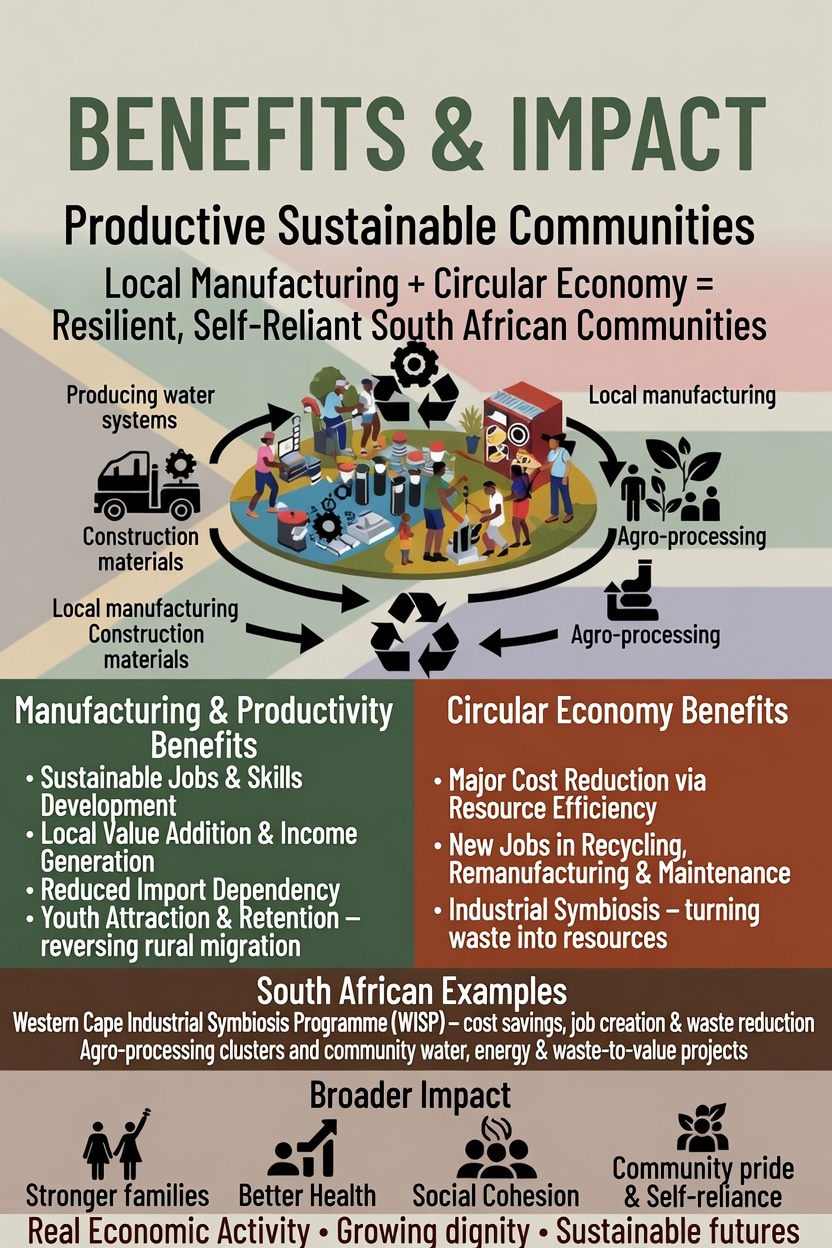
The true measure of any development model lies in the real, lasting benefits it delivers to people and communities. The Productive Sustainable Communities model is built to generate tangible economic value while strengthening social cohesion and restoring dignity.
At its core, the model focuses on building local productive capacity and applying circular economy principles. These are practical strategies that create employment, reduce costs, generate new economic opportunities, and build more resilient communities. By rooting economic activity in local skills and resources, the benefits stay within communities rather than flowing outward.
A central strength of the model is its emphasis on local manufacturing and productive activity. Rather than depending primarily on external employment or government transfers, communities are supported to produce goods and services that meet both local needs and external demand.
Manufacturing and production activities generate ongoing employment directly linked to skills development. These are not temporary or project-based jobs. As local capacity grows and markets expand, employment opportunities can increase over time.
By processing raw materials locally or manufacturing essential goods, communities capture more economic value instead of simply exporting raw resources.
Local production lowers reliance on expensive goods imported from urban centres, helping to keep money circulating within the local economy.
Visible manufacturing and productive activity demonstrates to young people that there is meaningful, future-oriented work available in rural areas.
High unemployment and limited prospects in rural areas have wider consequences. Many young people migrate to already congested urban centres in search of work. This contributes to overcrowding, pressure on urban infrastructure, and increased competition for limited opportunities in cities.
At the same time, prolonged unemployment and a lack of meaningful prospects can erode hope and social cohesion. When people — especially young people — feel there is no dignified path forward, it can contribute to social strain, including higher levels of crime and community breakdown. Crime does not only harm victims directly; it also undermines trust, safety, and the everyday fabric of community life.
The Productive Sustainable Communities model offers a practical response to these interconnected challenges. By creating real employment through local production and skills development, it provides young people with alternatives to urban migration. More importantly, it offers a sense of purpose, agency, and belonging. When people have access to meaningful work and can see a future in their own communities, the social pressures that contribute to crime and fragmentation are reduced. Stable employment and community participation help rebuild social cohesion from the ground up.
The model strongly promotes circular economy principles — designing out waste, keeping materials and products in use, and regenerating natural systems. This approach delivers both environmental and significant economic advantages.
By reusing materials, minimising waste, and improving resource efficiency, communities can reduce operational and living costs over time.
Circular practices create new job opportunities in recycling, remanufacturing, maintenance, repair, and sustainable resource management.
Different activities within and around the community can exchange by-products and resources, creating mutual economic benefit while reducing overall waste.
Beyond direct economic gains, the model delivers wider benefits that strengthen the social fabric of communities:
Access to meaningful work and integrated care across generations creates greater stability and emotional security for families.
Better resource management and reduced environmental impact contribute to healthier living conditions.
Shared productive activity and intergenerational interaction help rebuild trust and connection within communities.
People gain a stronger sense of purpose and ownership when they see tangible results from their own skills and efforts.
By combining strong productivity and manufacturing capacity with circular economy principles, the model creates a powerful engine for poverty reduction and community development.
Employment is generated through real, sustainable economic activity. Resources are used more efficiently, lowering costs and environmental pressure. Young people can see viable and attractive futures in their own communities. And the overall effect is one of growing self-reliance, reduced social strain, and long-term hope — rather than continued cycles of unemployment, migration, and social breakdown.
© 2026 AuriGen • aurigen.co.za. All rights reserved. Unauthorized copying or distribution of content is prohibited.