Care and Skills Infrastructure Launch
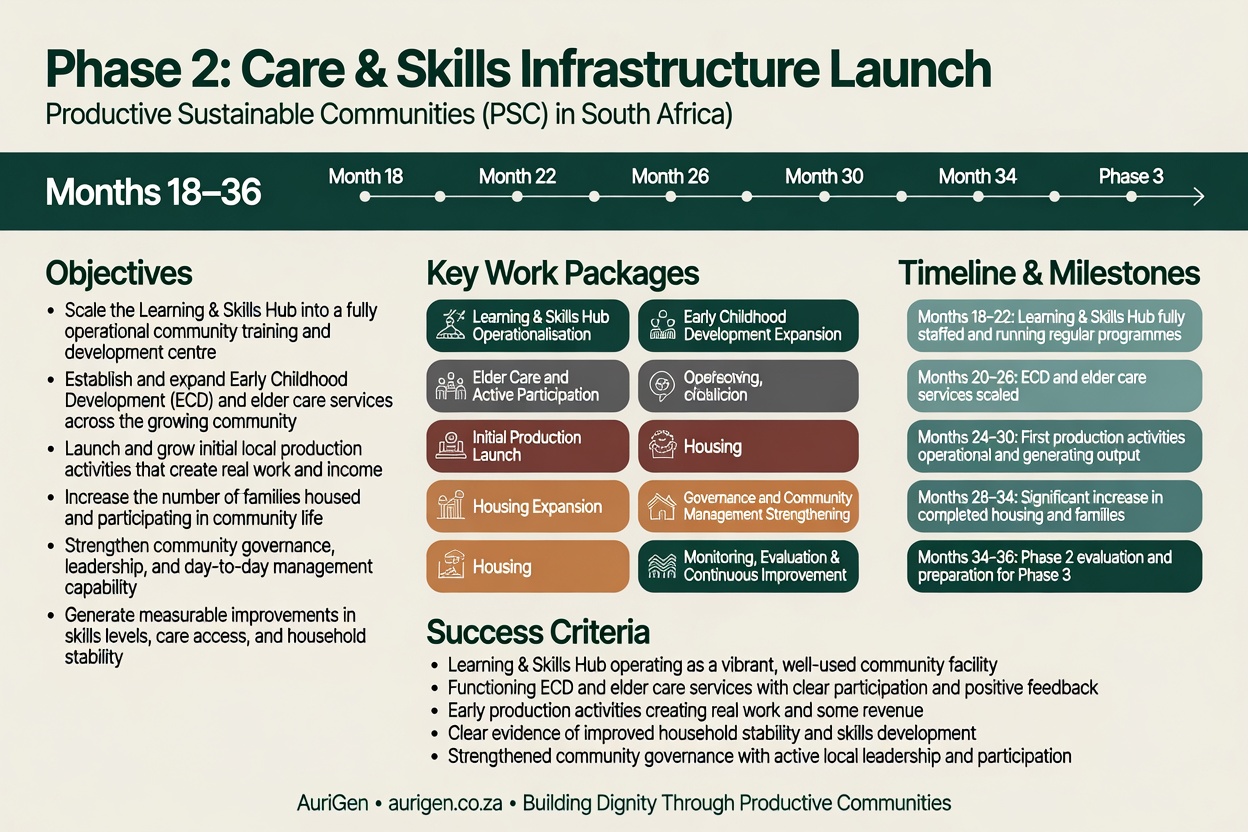
Months 18–36 – Scaling care, skills, and initial production
Months 18–36
This phase builds directly on the foundation established during the Proof of Concept. The focus shifts from validation and setup to scaling and operationalisation. The community begins to experience the integrated benefits of the model through expanded care services, active skills development, and the first meaningful steps toward local economic activity.
Months 18–36 – Scaling care, skills, and initial production
Full staffing, programme development, and regular delivery of training across construction, production, care, and life skills.
Scaling safe, nurturing ECD services with strong intergenerational involvement from elders.
Developing structured support and meaningful roles for older community members.
Establishing small-scale local manufacturing or agro-processing activities linked to training outcomes.
Increasing the number of completed homes to accommodate more families moving into the community.
Building local capacity for day-to-day management, decision-making, and conflict resolution.
Tracking progress against dignity indicators and operational metrics with regular feedback loops.
Success in Phase 2 is heavily dependent on the quality of the foundation laid in Phase 1 (especially governance and partnership strength). Early production activities should be closely linked to skills training to maximise employment outcomes.
Care services (ECD + elder care) are critical enablers for broader community participation, particularly for women. This phase marks the point where the community begins to move from setup into active, visible development.
© 2026 AuriGen • aurigen.co.za. All rights reserved. Unauthorized copying or distribution of content is prohibited.