Productive Economy Activation
Year 3–5 – Scaling production, markets and self-reliance
Year 3–5
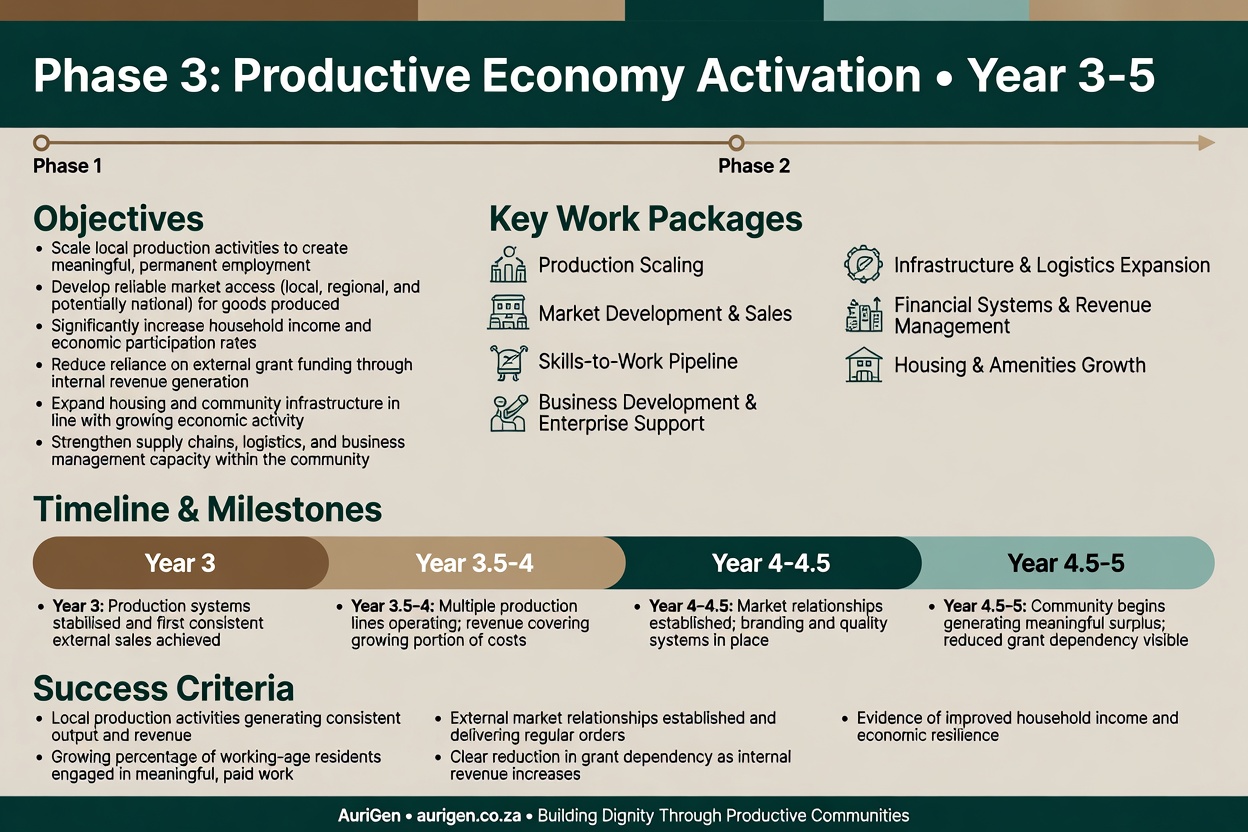
This phase marks the shift from foundation-building to economic activation. The community moves beyond grant dependency by scaling local production, creating sustainable employment, developing external market linkages, and generating real income within the community. The goal is to establish viable economic loops that make living and working in the community attractive and sustainable.
Year 3–5 – Scaling production, markets and self-reliance
Expanding and optimising initial production lines while identifying and launching additional viable enterprises.
Building relationships with buyers, distributors, and institutions; developing branding and quality standards.
Ensuring training programmes are tightly aligned with actual production and employment opportunities.
Supporting emerging micro-enterprises and cooperative models within the community.
Improving internal logistics, storage, and distribution systems to support growing production.
Establishing robust systems for pricing, costing, reinvestment, and profit distribution.
Continuing to expand housing in line with economic activity and incoming families.
Success in Phase 3 depends heavily on the quality and relevance of skills developed in previous phases. Market access is often the biggest challenge in rural production models — this must be actively developed from the start of the phase.
Quality control, pricing discipline, and reliable delivery will be critical to building external trust and repeat business. Governance and financial management capacity must keep pace with growing economic activity.
Phase 3 is where the model begins to prove its long-term viability. When local production, skills, and markets start working together, the community moves from being a recipient of support to becoming a generator of its own prosperity.
© 2026 AuriGen • aurigen.co.za. All rights reserved. Unauthorized copying or distribution of content is prohibited.