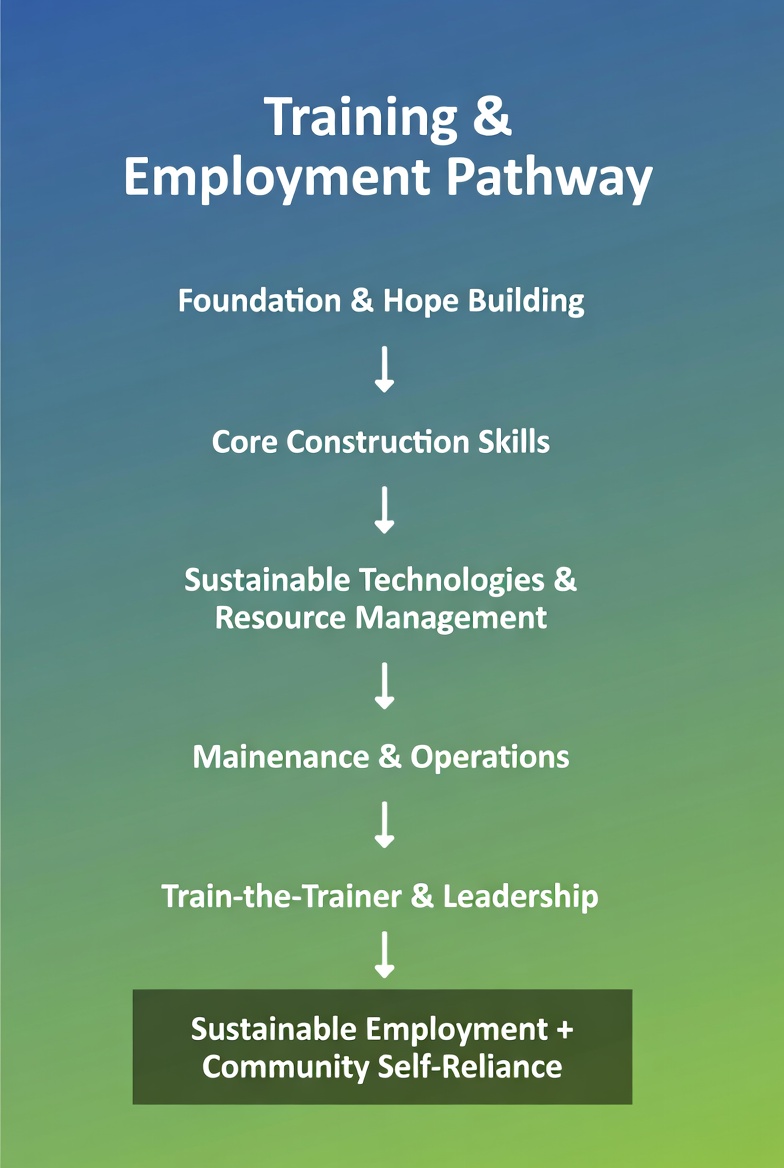
Employment is one of the most powerful tools for reducing poverty and restoring dignity. The Productive Sustainable Communities model places practical skills development and local economic activity at its core — not as isolated training programmes, but as pathways that lead to meaningful, sustainable work within the community itself.
By building real skills and linking them directly to local production and services, we create employment that allows people — especially young people — to build a future in their own communities rather than having to leave for the cities.
At the heart of the model is a dedicated Learning and Skills Development Hub — a physical and social centre where community members can access practical training, workshops, and ongoing learning.
The Hub is designed to be more than a classroom. It serves as a place where theory meets practice, where people can develop both technical skills and the confidence to apply them. Training is hands-on and directly connected to the community’s productive activities, including construction, manufacturing, agro-processing, maintenance, and resource management.
This ensures that skills are not developed in isolation but are immediately relevant and applicable. The Hub also plays a key role in the Train-the-Trainer approach — participants don’t just learn skills for themselves; they are equipped to train others. This multiplies the impact and creates layers of employment within the community.
Skills only create lasting value when they lead to real economic activity. The model therefore actively supports the development of local manufacturing and production capacity.
This includes the production of construction materials, household essentials, agro-processed goods, and components for water and energy systems. By producing goods locally, communities can meet their own needs at lower cost while also generating income by selling to nearby towns and urban markets.
This creates a powerful economic loop: skills development leads to production, production creates employment, and employment strengthens families and communities. It also makes rural life more economically viable — giving young people a realistic reason to stay or return, rather than seeing migration to the city as their only option.
A key part of building self-reliant communities is the ability to manage resources wisely. The model includes training in circular economy practices, renewable energy systems, water conservation, and waste reduction.
These skills not only reduce long-term costs but also create new employment opportunities in maintenance, recycling, and sustainable technologies. When communities can maintain their own infrastructure and manage their resources efficiently, they become less dependent on external support and more resilient in the face of change.
Skills development, local production, and sustainable resource management are deliberately connected. Training feeds directly into productive work. Production creates ongoing demand for skills. Resource efficiency reduces costs and creates new types of employment.
When these elements reinforce one another, communities develop genuine economic strength. Young people can see a viable, dignified future in their own rural spaces — not as a compromise, but as a positive choice. This is how we turn skills into sustainable employment and sustainable employment into poverty reduction.
© 2026 AuriGen • aurigen.co.za. All rights reserved. Unauthorized copying or distribution of content is prohibited.