Full Integration and Self-Reliance
Year 5–7 – Achieving operational and financial independence
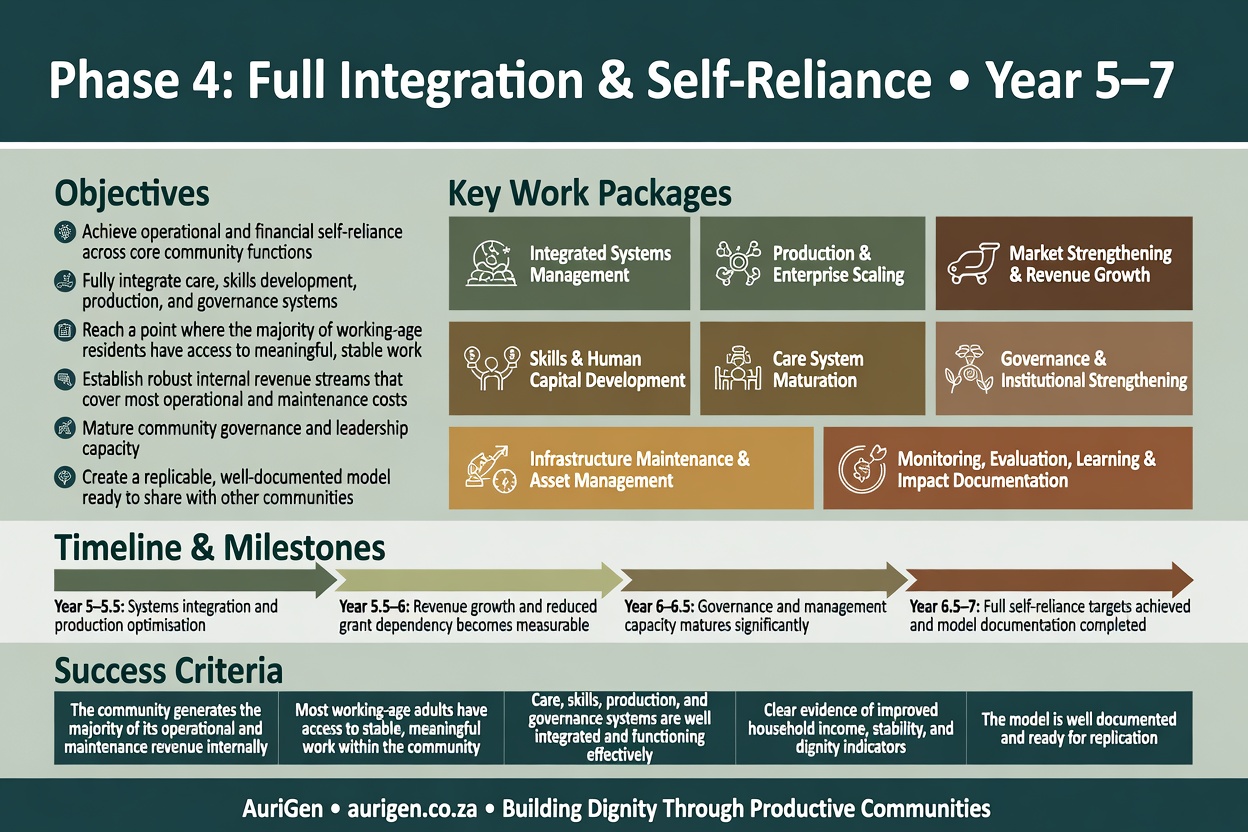
Year 5–7
This is the phase where the community transitions into a genuinely self-sustaining system. The various elements — care, skills, production, governance, and resource management — become fully integrated. The community shifts from being largely dependent on external support to generating its own economic and social stability.
Year 5–7 – Achieving operational and financial independence
Develop and implement systems that link care services, skills training, production, and resource management into a coordinated whole. Create feedback loops between functions.
Optimise and expand existing production lines. Identify and develop additional high-potential enterprises. Improve operational efficiency, quality control, and supply chain reliability.
Deepen existing market relationships and secure longer-term contracts. Develop new market channels. Build stronger branding, quality certification, and customer service capacity.
Evolve the Learning & Skills Hub into a centre of ongoing learning and innovation. Develop advanced and specialised skills. Create pathways for community members to move into supervisory and management roles.
Fully embed and sustainably fund ECD and elder care services. Integrate care services more deeply with economic activity. Develop preventive health and wellness programmes.
Mature community governance structures with clear policies, succession planning, and accountability. Strengthen financial management, procurement, and compliance systems.
Establish proper maintenance systems and budgets for all physical assets. Develop community capacity for ongoing repairs and preventive maintenance. Create sinking funds for major asset replacement.
Implement a mature monitoring and evaluation system focused on both economic and dignity indicators. Document the model thoroughly for replication and knowledge sharing.
Phase 4 success depends on strong foundations from previous phases (especially governance, skills relevance, and early market access). Financial discipline and reinvestment habits established earlier become critical.
External market conditions will influence how quickly full self-reliance can be achieved. Phase 4 represents the point at which the community proves it can stand on its own — not in isolation, but as a resilient, self-directed system capable of continuous improvement and contribution.
© 2026 AuriGen • aurigen.co.za. All rights reserved. Unauthorized copying or distribution of content is prohibited.