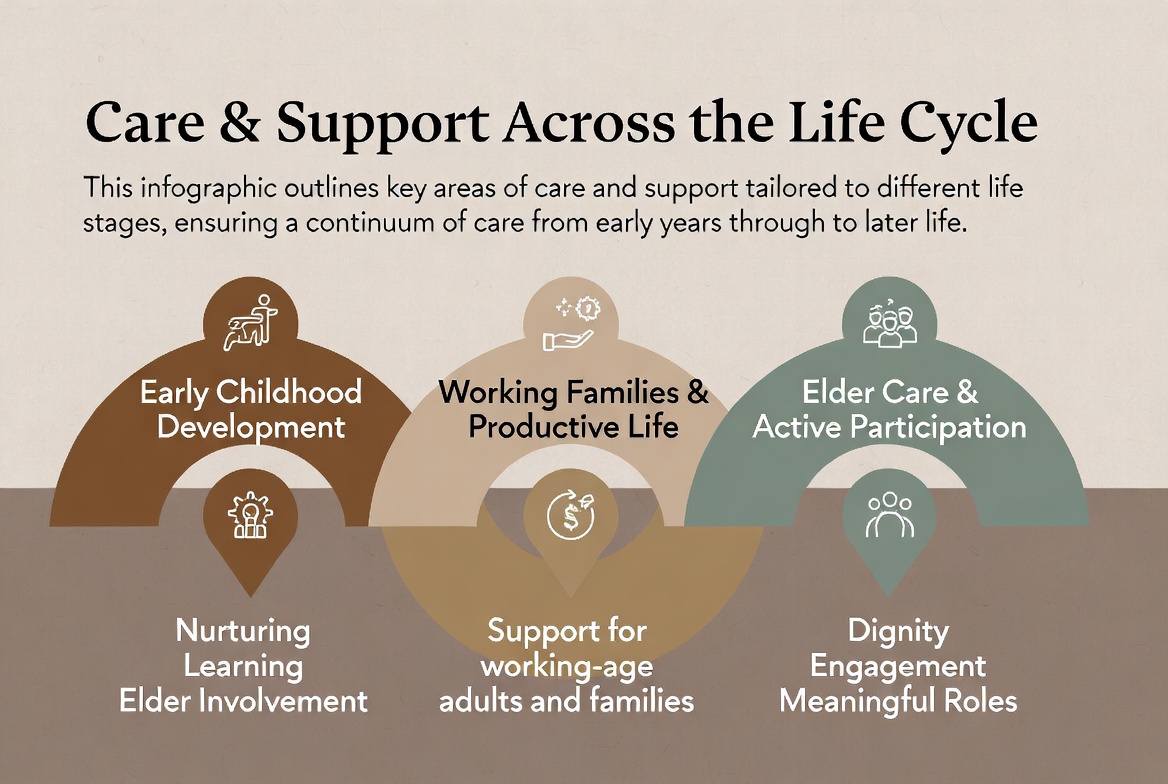
Dignity is not something reserved for working-age adults. It must be present from the earliest years through to old age. The Productive Sustainable Communities model therefore places integrated care at the centre of community life — not as an add-on or welfare function, but as a foundation that enables people to participate fully in learning, work, family, and community.
When children are well cared for, elders remain valued, and families have access to responsive healthcare, communities become more stable, resilient, and capable of building their own futures.
The early years of a child’s life lay the foundation for everything that follows — health, learning, relationships, and future productivity. Our approach to Early Childhood Development is therefore both practical and intergenerational.
We support the creation of safe, nurturing environments for children from six months to six years. These facilities combine quality early learning with responsive care. Importantly, they are designed to actively involve elders — through storytelling, cultural education, and mentoring. This approach supports children’s emotional and cognitive development while giving older community members meaningful roles and helping to transmit cultural knowledge across generations.
By investing in the early years with dignity and cultural continuity, we lay the groundwork for children to grow into capable, grounded adults who can contribute to their communities.
Older people are often treated as a problem to be managed rather than as assets to be valued. The model takes a different view. Elders are repositories of experience, culture, wisdom, and memory. Supporting them to age with dignity is not only a moral imperative — it also strengthens the social fabric of the community.
We promote care arrangements that allow elders to remain in their communities and maintain their independence for as long as possible. Where additional support is needed, it is delivered with respect and in ways that preserve dignity.
At the same time, elders are actively encouraged to participate in community life — particularly in Early Childhood Development, cultural education, and advisory roles. This restores traditional values of respect for elders while giving them continued purpose and connection.
Dignity in old age is as important as dignity in childhood. When elders are respected and engaged, the entire community benefits from their presence and guidance.
Healthcare works best when it is accessible, preventive, and connected to the real lives of families. The model therefore integrates primary healthcare with other community functions rather than treating it as a standalone service.
This includes community health workers, local clinics, and outreach teams that work closely with Early Childhood Development centres, elder care initiatives, and skills programmes. Services focus on prevention, nutrition, chronic disease management, and maternal and child health — areas that have the greatest long-term impact on community well-being.
By bringing healthcare closer to people and linking it with care, nutrition, and skills development, we reduce the burden of illness, support working families, and create local employment opportunities in the health and care sectors.
Care across the life cycle is not a collection of isolated programmes. When Early Childhood Development, elder participation, and integrated healthcare reinforce one another, families become more stable and resilient.
Children grow up in nurturing environments. Working-age adults can focus on productive work knowing their children and elders are supported. Older people remain connected and valued rather than isolated.
This social foundation is essential. Without it, economic development efforts often fail because families are too fragile to participate fully. When care is strong, communities are better able to take advantage of skills development, local production, and opportunities for self-reliance.
© 2026 AuriGen • aurigen.co.za. All rights reserved. Unauthorized copying or distribution of content is prohibited.